* Add 1 Part 4265b Light Gray Technic, Bush 1/2 Toothed Type II (Extra)
* Add 1 Part 4274 Light Gray Technic, Pin 1/2 (Extra)
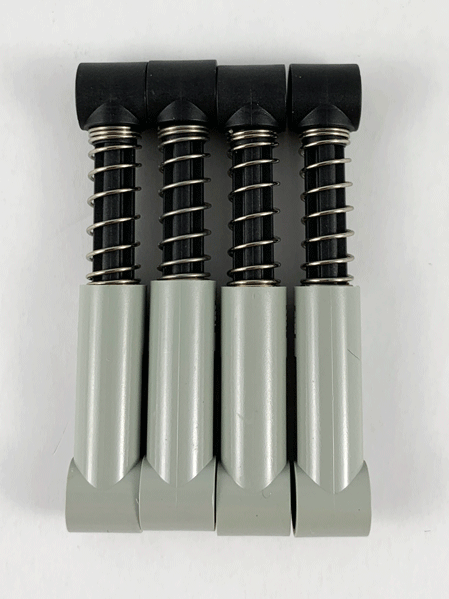
* Change 2 Part Light Gray {731c01 Technic, Shock Absorber 6.5L (Undetermined Spring Type) to 731c05 Technic, Shock Absorber 6.5L - Normal Spring}
Comments from Submitter:
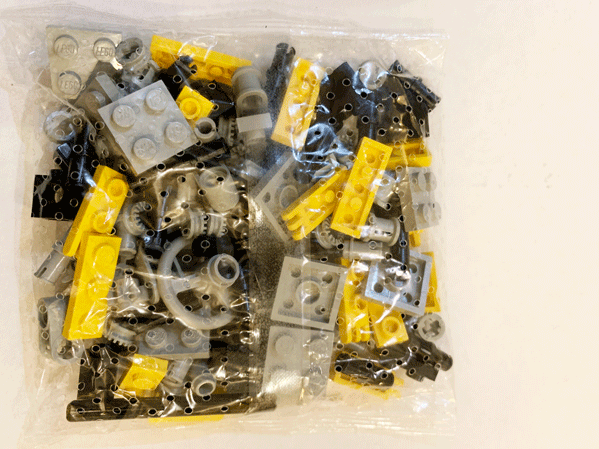
I realize you can't count the extras in the pic I am providing, but it was the best that I had. I actually parted out two of the set simultaneously and the extras were consistent on both (in addition to being very typical).
* Add 1 Part 4265b Light Gray Technic, Bush 1/2 Toothed Type II (Extra)
* Add 1 Part 4274 Light Gray Technic, Pin 1/2 (Extra)
* Change 2 Part Light Gray {731c01 Technic, Shock Absorber 6.5L (Undetermined Spring Type) to 731c05 Technic, Shock Absorber 6.5L - Normal Spring}
Comments from Submitter:
I realize you can't count the extras in the pic I am providing, but it was the best that I had. I actually parted out two of the set simultaneously and the extras were consistent on both (in addition to being very typical).
* Add 1 Part 4265b Light Gray Technic, Bush 1/2 Toothed Type II (Extra)
* Add 1 Part 4274 Light Gray Technic, Pin 1/2 (Extra)
* Change 2 Part Light Gray {731c01 Technic, Shock Absorber 6.5L (Undetermined Spring Type) to 731c05 Technic, Shock Absorber 6.5L - Normal Spring}
Comments from Submitter:
I realize you can't count the extras in the pic I am providing, but it was the best that I had. I actually parted out two of the set simultaneously and the extras were consistent on both (in addition to being very typical).
I feel uncomfortable changing these springs sometimes because the distinction
between "soft" and "normal" springs is on a scale and not dichotomous. "Soft"
springs are relatively easy to classify if they have only 4 to 5 turns, whereas
"normal" springs are relatively easy to classify if they have 7 to 8 turns. Its
the ones in the 5 to 7 range that are not easily classifiable, and the spring
in this image falls in that range.
* Add 1 Part 4265b Light Gray Technic, Bush 1/2 Toothed Type II (Extra)
* Add 1 Part 4274 Light Gray Technic, Pin 1/2 (Extra)
* Change 2 Part Light Gray {731c01 Technic, Shock Absorber 6.5L (Undetermined Spring Type) to 731c05 Technic, Shock Absorber 6.5L - Normal Spring}
Comments from Submitter:
I realize you can't count the extras in the pic I am providing, but it was the best that I had. I actually parted out two of the set simultaneously and the extras were consistent on both (in addition to being very typical).
I feel uncomfortable changing these springs sometimes because the distinction
between "soft" and "normal" springs is on a scale and not dichotomous. "Soft"
springs are relatively easy to classify if they have only 4 to 5 turns, whereas
"normal" springs are relatively easy to classify if they have 7 to 8 turns. Its
the ones in the 5 to 7 range that are not easily classifiable, and the spring
in this image falls in that range.
They weren't all the same. I struggled with it a little. I'll get you
a picture of all 4 and we can try to average it out. But I think you are right
if you are saying that we have made 3 distinct classifications of spring where
perhaps Lego did not.
* Add 1 Part 4265b Light Gray Technic, Bush 1/2 Toothed Type II (Extra)
* Add 1 Part 4274 Light Gray Technic, Pin 1/2 (Extra)
* Change 2 Part Light Gray {731c01 Technic, Shock Absorber 6.5L (Undetermined Spring Type) to 731c05 Technic, Shock Absorber 6.5L - Normal Spring}
Comments from Submitter:
I realize you can't count the extras in the pic I am providing, but it was the best that I had. I actually parted out two of the set simultaneously and the extras were consistent on both (in addition to being very typical).
I feel uncomfortable changing these springs sometimes because the distinction
between "soft" and "normal" springs is on a scale and not dichotomous. "Soft"
springs are relatively easy to classify if they have only 4 to 5 turns, whereas
"normal" springs are relatively easy to classify if they have 7 to 8 turns. Its
the ones in the 5 to 7 range that are not easily classifiable, and the spring
in this image falls in that range.
And on top of that, I have a feeling that BrickLink's part descriptions are
not accurate. I measured some shock absorbers from my sets some time ago and
found the "soft" spring type much harder than the "normal" spring type. This
is also shown here:
https://news.lugnet.com/technic/?n=16651
(That image also suggests that the spring with 4-5 turns can be in the normal
or in the soft range - that would mean 731c06 is still "undetermined".)
Well they aren't all the same, but they are all in your ambiguous range.
And I think if I had taken this picture last night, I would have asked for soft
instead of normal.
* Add 1 Part 4265b Light Gray Technic, Bush 1/2 Toothed Type II (Extra)
* Add 1 Part 4274 Light Gray Technic, Pin 1/2 (Extra)
* Change 2 Part Light Gray {731c01 Technic, Shock Absorber 6.5L (Undetermined Spring Type) to 731c05 Technic, Shock Absorber 6.5L - Normal Spring}
Comments from Submitter:
I realize you can't count the extras in the pic I am providing, but it was the best that I had. I actually parted out two of the set simultaneously and the extras were consistent on both (in addition to being very typical).
I feel uncomfortable changing these springs sometimes because the distinction
between "soft" and "normal" springs is on a scale and not dichotomous. "Soft"
springs are relatively easy to classify if they have only 4 to 5 turns, whereas
"normal" springs are relatively easy to classify if they have 7 to 8 turns. Its
the ones in the 5 to 7 range that are not easily classifiable, and the spring
in this image falls in that range.


 USA, Oklahoma


)
)


 Germany, Niedersachsen