since yesterday, we are experiencing an issue when trying to send messages through
Bricklink (please see screenshot), saying that messages with links aren't
allowed.
Since none of the messages contains links, we are wondering why this happens.
Also, this does not affect all messages. I think the problem only appears if
we use prewritten messages that we simply copy and paste.
Anybody else experiencing this issue? Is there maybe a new scam prevention blocking
pasted messages?
since yesterday, we are experiencing an issue when trying to send messages through
Bricklink (please see screenshot), saying that messages with links aren't
allowed.
Since none of the messages contains links, we are wondering why this happens.
Also, this does not affect all messages. I think the problem only appears if
we use prewritten messages that we simply copy and paste.
Anybody else experiencing this issue? Is there maybe a new scam prevention blocking
pasted messages?
Thanks!
The link detection thing seems a little “interesting” in its implementation,
could you share an example of a message that won’t send (minus personal details
if any) and we can see if something stands out perhaps
since yesterday, we are experiencing an issue when trying to send messages through
Bricklink (please see screenshot), saying that messages with links aren't
allowed.
Since none of the messages contains links, we are wondering why this happens.
Also, this does not affect all messages. I think the problem only appears if
we use prewritten messages that we simply copy and paste.
Anybody else experiencing this issue? Is there maybe a new scam prevention blocking
pasted messages?
Thanks!
The link detection thing seems a little “interesting” in its implementation,
could you share an example of a message that won’t send (minus personal details
if any) and we can see if something stands out perhaps
Thanks for your response.
I think we already figured out what cause the issue (thanks to another member
allowing us to spam him with test messages).
Seems to be caused when the message contains numbers with a ".", e.g.
1.000EUR seems to be detected as a link. 1000EUR seems to be working fine.
since yesterday, we are experiencing an issue when trying to send messages through
Bricklink (please see screenshot), saying that messages with links aren't
allowed.
Since none of the messages contains links, we are wondering why this happens.
Also, this does not affect all messages. I think the problem only appears if
we use prewritten messages that we simply copy and paste.
Anybody else experiencing this issue? Is there maybe a new scam prevention blocking
pasted messages?
Thanks!
The link detection thing seems a little “interesting” in its implementation,
could you share an example of a message that won’t send (minus personal details
if any) and we can see if something stands out perhaps
Thanks for your response.
I think we already figured out what cause the issue (thanks to another member
allowing us to spam him with test messages).
Seems to be caused when the message contains numbers with a ".", e.g.
1.000EUR seems to be detected as a link. 1000EUR seems to be working fine.
Best regards,
Wanja
Glad to hear you caught it! Yeah, it seams any characters following a “.” Gets
flagged as a url
since yesterday, we are experiencing an issue when trying to send messages through
Bricklink (please see screenshot), saying that messages with links aren't
allowed.
Since none of the messages contains links, we are wondering why this happens.
Also, this does not affect all messages. I think the problem only appears if
we use prewritten messages that we simply copy and paste.
Anybody else experiencing this issue? Is there maybe a new scam prevention blocking
pasted messages?
Thanks!
The link detection thing seems a little “interesting” in its implementation,
could you share an example of a message that won’t send (minus personal details
if any) and we can see if something stands out perhaps
Thanks for your response.
I think we already figured out what cause the issue (thanks to another member
allowing us to spam him with test messages).
Seems to be caused when the message contains numbers with a ".", e.g.
1.000EUR seems to be detected as a link. 1000EUR seems to be working fine.
Best regards,
Wanja
Glad to hear you caught it! Yeah, it seams any characters following a “.” Gets
flagged as a url
So £5.95 is a scam website! As is 30.5cm. With programming that sloppy it is
surprising you cannot order -1000 of an item and get a payday from a seller as
they owe you money. That is similar to a question in my first ever programming
course 40 years ago, where you had to write a rudimentary stock system to keep
track of how much stock of one item there was and how much to charge when there
was a discount if buying more than 5. You had to reject orders where there was
not enough stock but many students didn’t think about a block for orders where
a customer tried to order a negative amount and got paid for doing so, designed
to make you think about how to handle all input and not just the input you expect.
since yesterday, we are experiencing an issue when trying to send messages through
Bricklink (please see screenshot), saying that messages with links aren't
allowed.
Since none of the messages contains links, we are wondering why this happens.
Also, this does not affect all messages. I think the problem only appears if
we use prewritten messages that we simply copy and paste.
Anybody else experiencing this issue? Is there maybe a new scam prevention blocking
pasted messages?
Thanks!
The link detection thing seems a little “interesting” in its implementation,
could you share an example of a message that won’t send (minus personal details
if any) and we can see if something stands out perhaps
Thanks for your response.
I think we already figured out what cause the issue (thanks to another member
allowing us to spam him with test messages).
Seems to be caused when the message contains numbers with a ".", e.g.
1.000EUR seems to be detected as a link. 1000EUR seems to be working fine.
Best regards,
Wanja
Glad to hear you caught it! Yeah, it seams any characters following a “.” Gets
flagged as a url
So £5.95 is a scam website! As is 30.5cm. With programming that sloppy it is
surprising you cannot order -1000 of an item and get a payday from a seller as
they owe you money. That is similar to a question in my first ever programming
course 40 years ago, where you had to write a rudimentary stock system to keep
track of how much stock of one item there was and how much to charge when there
was a discount if buying more than 5. You had to reject orders where there was
not enough stock but many students didn’t think about a block for orders where
a customer tried to order a negative amount and got paid for doing so, designed
to make you think about how to handle all input and not just the input you expect.
I'm absolutely astonished this isn't tested in a sandbox before being
pushed out.
I'm absolutely astonished this isn't tested in a sandbox before being
pushed out.
I'm sure it is, they just didn't think of this use case. And honestly,
detecting URLs isn't easy.
Indeed, it seems a little difficult, https isn’t included in all of them, neither
is www. The only other option that really comes to mind would be to create a
master list of every url end (such as .com .ca, etc) and block them which seems
a bit crazy, and to prevent the spammers I’d rather restrictions be a little
over then under.
I'm absolutely astonished this isn't tested in a sandbox before being
pushed out.
I'm sure it is, they just didn't think of this use case. And honestly,
detecting URLs isn't easy.
Indeed, it seems a little difficult, https isn’t included in all of them, neither
is www. The only other option that really comes to mind would be to create a
master list of every url end (such as .com .ca, etc) and block them which seems
a bit crazy, and to prevent the spammers I’d rather restrictions be a little
over then under.
The thing about URL endings (top-level domains) is that there's not a master
list any more. Of course registering a new one costs a lot of money but the list
isn't constant (so if you had a lot of $$$$ you could register .nubs).
I think what I would do is say characters dot characters is a URL unless all
the characters are numeric. But maybe that's not quite enough.
I'm absolutely astonished this isn't tested in a sandbox before being
pushed out.
I'm sure it is, they just didn't think of this use case. And honestly,
detecting URLs isn't easy.
Indeed, it seems a little difficult, https isn’t included in all of them, neither
is www. The only other option that really comes to mind would be to create a
master list of every url end (such as .com .ca, etc) and block them which seems
a bit crazy, and to prevent the spammers I’d rather restrictions be a little
over then under.
The thing about URL endings (top-level domains) is that there's not a master
list any more. Of course registering a new one costs a lot of money but the list
isn't constant (so if you had a lot of $$$$ you could register .nubs).
Indeed
I think what I would do is say characters dot characters is a URL unless all
the characters are numeric. But maybe that's not quite enough.
I looked it up and it seems it is possible to have urls that include numbers
both before and after the . (Tho after the . Is much rarer)
I looked it up and it seems it is possible to have urls that include numbers
both before and after the . (Tho after the . Is much rarer)
Ip addresses are valid for links too
3.255.40.74 is bricklink.com
Excellent point. So we'd need to do a bit more to make an exception for currency/numbers.
Finding proper URLs and email addresses is actually easy but one problem is that
PMs are also received by email.
Properly, an URL has a column in it («scheme»:«blah», like http://www.example.com
or mailto:bozo@127.0.0.1 or ftp://::1/form.pdf) and an email address as an at
sign in it.
So it doesn’t has to be simply “period with no space after”….
But I understand that some mail readers are too “smart” and make active links
of things that are not proper URLs (making www.example.com clickable while it
lacks the proper http:// bit).
And the other problem is that some users could have the bad idea to copy-paste
the text: “Oh, their link doesn’t work, but I don’t want my store closed! Quick,
let’s copy ‘www.example.com’ in the URL/search bar!”
since yesterday, we are experiencing an issue when trying to send messages through
Bricklink (please see screenshot), saying that messages with links aren't
allowed.
Since none of the messages contains links, we are wondering why this happens.
Also, this does not affect all messages. I think the problem only appears if
we use prewritten messages that we simply copy and paste.
Anybody else experiencing this issue? Is there maybe a new scam prevention blocking
pasted messages?
Thanks!
The link detection thing seems a little “interesting” in its implementation,
could you share an example of a message that won’t send (minus personal details
if any) and we can see if something stands out perhaps
Thanks for your response.
I think we already figured out what cause the issue (thanks to another member
allowing us to spam him with test messages).
Seems to be caused when the message contains numbers with a ".", e.g.
1.000EUR seems to be detected as a link. 1000EUR seems to be working fine.
Best regards,
Wanja
Glad to hear you caught it! Yeah, it seams any characters following a “.” Gets
flagged as a url
So £5.95 is a scam website! As is 30.5cm. With programming that sloppy it is
surprising you cannot order -1000 of an item and get a payday from a seller as
they owe you money.
Good idea, but kind of already exists
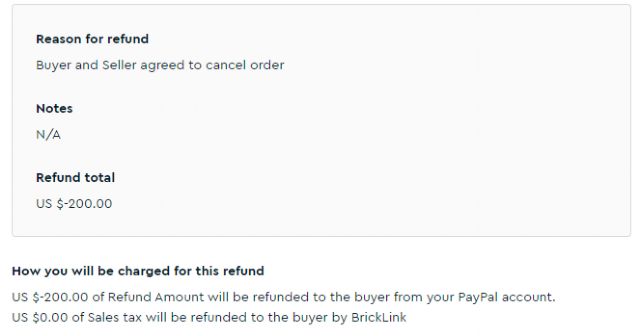
But I didn't press the "Submit refund to..." button to verify
No photoshop, type 0 and then use the arrow down key to make the number negative.
since yesterday, we are experiencing an issue when trying to send messages through
Bricklink (please see screenshot), saying that messages with links aren't
allowed.
Since none of the messages contains links, we are wondering why this happens.
Also, this does not affect all messages. I think the problem only appears if
we use prewritten messages that we simply copy and paste.
Anybody else experiencing this issue? Is there maybe a new scam prevention blocking
pasted messages?
Thanks!
Today a buyer asked me how much shipping to the USA is but I am unable to send
a short reply because I get the same message about links not being allowed.
[…]
Today a buyer asked me how much shipping to the USA is but I am unable to send
a short reply because I get the same message about links not being allowed.
Replace all the dots (.) in your numbers by commas (,) or central point (·) or
add a space after each one….


 Germany, Niedersachsen




 Canada, Ontario

 United Kingdom, England

 USA, Ohio
 France, Nouvelle-Aquitaine


 Netherlands, Zuid-Holland