It has no meaning, or rather, it means whatever you want it to.
Apparently Turez (ha!) wrote on brickset:
By Turez in Germany, 02 Jul 2020 10:02
The official meaning of LRTS is "LEGO Railway Train System" and it has
been revealed in the "Help Topics" on the consumer service pages back
at the time when set 10194 was available.
You're asking a bunch of googlies to give you what I assume you've already gleaned for yourself
Tell me why you what to know, and I'll tell you what the characters really "translate to"
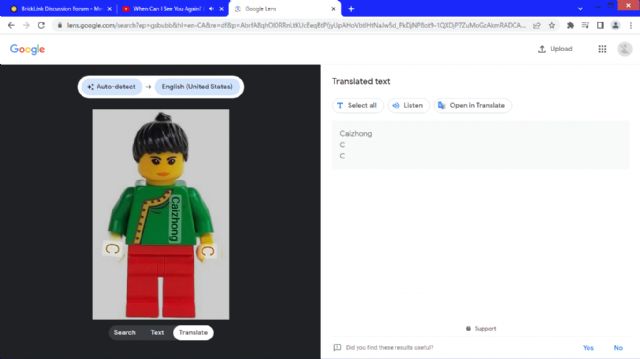
I actually have no idea what they mean. I do not speak Chinese, and I am not
sure what to start putting into Google Translate.
The reason that I want to know, is because the characters are not defined in
the title of the Minifig’s torso, as logograms are on other Catalog entries.
I'm not sure why others google translates are coming up with nonsense. It's
a principle from Confucian teachings. Called Zhongyan according to my search.
Which makes more sense than randomness IMO
I'm not sure why others google translates are coming up with nonsense. It's
a principle from Confucian teachings. Called Zhongyan according to my search.
Which makes more sense than randomness IMO
Crystal
That looks different than the torso design; “Zhōng” (“中”) is definitely the second
character, though.
I found the actual characters typed on Brickipedia, which are “禾中”; they translate
to “grain” and either “within”, “China”, or “to hit”. I have no idea what the
designers meant by this, though it may connect to Jing Lee being a wanderer -
“Within Grain”, perhaps? Still weird, though, and I am not sure how it should
be catalogued. 🫤
Also, the “禾“ character does not appear to be the same as the one on the Minifig,
as the torso has what looks like an ‘X’ with a ‘T’ through it, while the “禾“
character (sourced from Brickipedia) looks different. 🤔
I found the actual characters typed on Brickipedia, which are “禾中”; they translate
to “grain” and either “within”, “China”, or “to hit”. I have no idea what the
designers meant by this, though it may connect to Jing Lee being a wanderer -
“Within Grain”, perhaps? Still weird, though, and I am not sure how it should
be catalogued. 🫤
Also, the “禾“ character does not appear to be the same as the one on the Minifig,
as the torso has what looks like an ‘X’ with a ‘T’ through it, while the “禾“
character (sourced from Brickipedia) looks different. 🤔
I put those exact Characters into translate and got the answer I gave you. Keep
in mind Character meaning change with sequence. You can't just direct translate
the two characters.
FWIW I did translate again, and it came back as a prefecture in China
Pinyin transliterates Chinese characters using Latin letters, but it's not
an injective mapping. Two different characters can have the same pinyin spelling
and this can cause confusion.
For example, 中 (middle) and 种 (seed) are both transliterated as zhong.
Accents can be used to indicate tone, for example 中 (zhōng) and 种 (zhǒng).
But even this isn't unique. 禾 (grain) and 河 (river) are both transliterated
as hé.
Pinyin transliterates Chinese characters using Latin letters, but it's not
an injective mapping. Two different characters can have the same pinyin spelling
and this can cause confusion.
For example, 中 (middle) and 种 (seed) are both transliterated as zhong.
Accents can be used to indicate tone, for example 中 (zhōng) and 种 (zhǒng).
But even this isn't unique. 禾 (grain) and 河 (river) are both transliterated
as hé.
Thank you for explaining it better than I ever could.
Personally I'm not sure why someone hasn't just jumped on a discord server
or reddit and asked someone.
Thank you for explaining it better than I ever could.
Personally I'm not sure why someone hasn't just jumped on a discord server
or reddit and asked someone.
Thinking about this translation problem... then just this one appeared; please
check out Matt Parker here, always fun and interesting:
Thank you for explaining it better than I ever could.
Personally I'm not sure why someone hasn't just jumped on a discord server
or reddit and asked someone.
Thinking about this translation problem... then just this one appeared; please
check out Matt Parker here, always fun and interesting:
Better question is: why are so many non-Chinese speaking people answering this
post, quoting what anyone could find on Google?
The google translated version is probably the best thing to include in the description.
If I found one and wanted a keyword to search with, I'd scan it in google
lens and look at the translation. Of course, if using google lens or similar,
it would probably find the torso anyway, but including the translation in the
title is still a good idea.
If it is "求中", i guess it is "pray to win", like a lucky draw,
pray my number match it.
I see below reply say, it is "禾中", seems not correct. As below part is
"水"
However, i see the word is not same as "求", as the vertical stroke is
not "protrude" to the top and not "dot" in right corner.
There is no such chinese word as "一水", the "一" is on the top
of "水"
OR Just LEGO create wrong?
Nice explanation. Thank you.
Good to know Hong Kong and Macau members will still be around. Not just for
these things, but more for the excellent BL commerce they generate, especially
Hong Kong
If it is "求中", i guess it is "pray to win", like a lucky draw,
pray my number match it.
I see below reply say, it is "禾中", seems not correct. As below part is
"水"
However, i see the word is not same as "求", as the vertical stroke is
not "protrude" to the top and not "dot" in right corner.
There is no such chinese word as "一水", the "一" is on the top
of "水"
OR Just LEGO create wrong?
thanks
I often translate kanji on LEGO. I cannot read Chinese at all, but I know a
lot of tools to help me and my sister-in-law is Chinese. When a character eludes
me it is always because the print has simplified things in ways that to me seem
like they'd be important, but to an actual Chinese reader it is like nothing
happened. Perhaps like a lower-case A that sometimes wears a hat and other times
does not, but no English reader ever gets tripped by it for even a moment.
I often translate kanji on LEGO. I cannot read Chinese at all, but I know a
lot of tools to help me and my sister-in-law is Chinese. When a character eludes
me it is always because the print has simplified things in ways that to me seem
like they'd be important, but to an actual Chinese reader it is like nothing
happened. Perhaps like a lower-case A that sometimes wears a hat and other times
does not, but no English reader ever gets tripped by it for even a moment.
Chinese is not my first language, but it's not obvious to me what character
it might be a simplification of. 求, 采, and 禾 are close matches, but none is exact.
It could be a misprint or maybe it is not even intended to represent a real character.


 USA, Virginia


 Canada, Ontario


 Australia, Queensland

 France, Provence-Alpes-Côte d'Azur



 Belgium, Brussels
 United Kingdom, England


 Hong Kong SAR China