i'm sure for many people bricklink is simply a hobby, as for me, but the
shops at the top can't be sinking thousands of hours and dollars into something
because it's fun right? i want to know where these colossal stores find their
profit. as a super tiny store, my investment in little ebay listing or lots is
minimal, and any profit tends to come from shipping costs. i'd love to expand,
but with no guarantee of orders, it's a little daunting to invest money into
items that might only be worth $10 more than i get it for. also i only care about
bionicle. lol.
i'm sure for many people bricklink is simply a hobby, as for me, but the
shops at the top can't be sinking thousands of hours and dollars into something
because it's fun right?
Who doesn't want to spend thousand of hours and dollars doing something fun?
i want to know where these colossal stores find their
profit. as a super tiny store, my investment in little ebay listing or lots is
minimal, and any profit tends to come from shipping costs. i'd love to expand,
but with no guarantee of orders, it's a little daunting to invest money into
items that might only be worth $10 more than i get it for. also i only care about
bionicle. lol.
You can definitely make money by selling on BrickLink, but the general consensus
is that you need a massive inventory. 100 lots will barely do you any good. I
used to have around 1,000 lots and I still only received a few orders per week.
Orders start to get more regular once you reach around 10,000 lots.
There's also some strategy involved in choosing items that will sell quickly
and/or increase in value. Basic parts are always in demand and rare items can
fetch quite a bit of money. Bionicle is not the most popular theme, but if you
have enough patience, you can sell just about anything here, even mustard.
is a big seller on BL but if you have 6 of them they're not going anywhere
for a while.
Hence why a massive inventory is needed. If the only thing you have in stock
is six technic pins, then you will not receive many orders. But if you have a
lot of other parts, then you will.
Maddie has a lot of Bionicle stuff which is not the best seller on BrickLink,
but it does sell.
Hence why a massive inventory is needed. If the only thing you have in stock
is six technic pins, then you will not receive many orders. But if you have a
lot of other parts, then you will.
What I'm saying (maybe not well) is that even if you have a lot of other
parts, your six technic pins may still not sell, even though they're always
in demand on BL. I don't think you need a massive inventory but you need
a decent inventory of things that sell.
What I'm saying (maybe not well) is that even if you have a lot of other
parts, your six technic pins may still not sell, even though they're always
in demand on BL. I don't think you need a massive inventory but you need
a decent inventory of things that sell.
If you have six technic pins for sale, even if you have other parts in stock,
those six technic pins might sit in your inventory for a very long time (months,
years, etc) before they sell. But one day, a buyer might order all six, and now
they are all gone.
Whereas if you have 116,719 technic pins for sale, people will buy them frequently,
but it's unlikely that a single buyer will order all of them. So, the supply
will also last a long time (months, years, etc).
But what's worth more: 6 technic pins, or 116,719 technic pins?
Hence why a "massive" (or at least "decent" ) inventory is needed
to make money on BrickLink, at least in the short term.
Now, Maddie has chosen a different, more long-term approach. She recognizes that
the Bionicle theme has been discontinued, so she collects it knowing that its
value will increase over time (or maybe she just really likes Bionicle).
So, 10+ years from now, she may sell it for double or triple what she bought
it for. But, it's not a short-term profit like 1001bricks, Nubs_Select, Brick
Takeover GmbH, etc.
But what's worth more: 6 technic pins, or 116,719 technic pins?
Wow, unbelievable coincidence!
So, 10+ years from now, she may sell it for double or triple what she bought
it for. But, it's not a short-term profit like 1001bricks, Nubs_Select, Brick
Takeover GmbH, etc.
But what's worth more: 6 technic pins, or 116,719 technic pins?
Wow, unbelievable coincidence!
So, 10+ years from now, she may sell it for double or triple what she bought
it for. But, it's not a short-term profit like 1001bricks, Nubs_Select, Brick
Takeover GmbH, etc.
If you have six technic pins for sale, even if you have other parts in stock,
those six technic pins might sit in your inventory for a very long time (months,
years, etc) before they sell. But one day, a buyer might order all six, and now
they are all gone.
There was a time when I would have bought those 6 technic pins, if I was purchasing
something else in the store.
There are parts on my wanted list that I am gradually accumulating, if I am in
a store buying something I specifically searched on, and the store has something
else on my wanted list, at what I consider a reasonable price (close to or below
average and lower than the price on the LEGO site), and it is not a part that
will cause my shipping to go up, I will add it to my cart.
If one has a small quantity of a part that is not rare and not a special part
where only one makes sense (such a printed part or character figure) pricing
it below average is a good idea.
is a big seller on BL but if you have 6 of them they're not going anywhere
for a while.
Absolutely hilarious (in my dull mind), after I read this thread I had an order
for six technic pins and a Bionicle connector! Granted, the order did not make
much money ($.83).
Orders start to get more regular once you reach around 10,000 lots.
In one sense you are correct, but the other variable is how many other sellers
are offering the same item/color. Many/most items offered in 2023 are from
recent sets, so the competition is against the same list of parts. Offering older
parts (which are still New) is a different ball game.
tl;dr If you offer something that is barely available elsewhere, buyers (and
auto-buy) will seek you out.
i'm sure for many people bricklink is simply a hobby, as for me, but the
shops at the top can't be sinking thousands of hours and dollars into something
because it's fun right? i want to know where these colossal stores find their
profit.
i'm sure for many people bricklink is simply a hobby, as for me, but the
shops at the top can't be sinking thousands of hours and dollars into something
because it's fun right? i want to know where these colossal stores find their
profit.
They buy low and sell high.
and sometimes with an event horizon that stretches over decades.
I've never investigated the regs concerning long term capital gains
but that may apply here.
i'm sure for many people bricklink is simply a hobby, as for me, but the
shops at the top can't be sinking thousands of hours and dollars into something
because it's fun right? i want to know where these colossal stores find their
profit.
They buy low and sell high.
and sometimes with an event horizon that stretches over decades.
I've never investigated the regs concerning long term capital gains
but that may apply here.
Nita Rae
ive been wondering how much of an investment bionicle is for my future lol it
isn't getting any younger and even in the past year ive seen prices increase,
so maybe i'm doing something good for myself by hoarding it all.
i'm sure for many people bricklink is simply a hobby, as for me, but the
shops at the top can't be sinking thousands of hours and dollars into something
because it's fun right? i want to know where these colossal stores find their
profit. as a super tiny store, my investment in little ebay listing or lots is
minimal, and any profit tends to come from shipping costs. i'd love to expand,
but with no guarantee of orders, it's a little daunting to invest money into
items that might only be worth $10 more than i get it for. also i only care about
bionicle. lol.
It was never about making money. It was about "Sell" to Pay for the LEGO
Crack addiction which some of us found out you could actually make money doing
it if you so desired too.
i'm sure for many people bricklink is simply a hobby, as for me, but the
shops at the top can't be sinking thousands of hours and dollars into something
because it's fun right?
I'd differentiate shops for business and simply professional ones, the latter
- like our shop - is just our only source for living.
Business ones have invested $Ms on Inventory, some of them have made this investment
just for their opening! We've seen some pictures in Forum about this.
We're not fighting in the same ring
i want to know where these colossal stores find their
profit. as a super tiny store, my investment in little ebay listing or lots is
minimal, and any profit tends to come from shipping costs. i'd love to expand,
but with no guarantee of orders, it's a little daunting to invest money into
items that might only be worth $10 more than i get it for. also i only care about
bionicle. lol.
One thing's sure, investing in a professional shop means 333% of your time
- and of course, 150% of the money that comes in.
But really the time aspect is very important, like dedicated 7/365 no holidays
ever, especially for low value lots, like Parts.
It's the same as shops selling iPhones vs the ones selling screws and bolts
I'd be you, I'd play it cool, cooler, especially if your in Bionicle
- which may represent maybe 1/100 of the wanted-lists or orders.
You may try to get a niche market, being a Bionicle specialist. Add a bit Technic,
some figs and basic parts (plates, bricks) for example.
Take a LOT of time thinking and trying, don't hesitate to change drastically
in the middle.
Think, calculate, make trials, do it slowly - use your time instead of spending/waisting
money
Read ALL BrickLink pages, especially TOS and Help.
i'm sure for many people bricklink is simply a hobby, as for me, but the
shops at the top can't be sinking thousands of hours and dollars into something
because it's fun right? i want to know where these colossal stores find their
profit. as a super tiny store, my investment in little ebay listing or lots is
minimal, and any profit tends to come from shipping costs. i'd love to expand,
but with no guarantee of orders, it's a little daunting to invest money into
items that might only be worth $10 more than i get it for. also i only care about
bionicle. lol.
In my view, if you can't make a certain percentage, it isn't worth doing
as a business. A lot of places on BrickLink use the platform to 'trade'
bricks. They sell what they have too much of, to fund the parts they need more
of. In the early days, the platform was built around a community that traded
rather than sold. The pricing was established to ensure fair trades.
As for my shop, in the heyday of selling, I was working about 4 hours a day in
the shop. I think that year, I made $35k off my efforts, figuring out cost, shop
rent, and everything else, I would have been better suited to working those hours
at my day job for overtime pay for several times that amount. Some items you
make decent money on, others, you're lucky to recoup costs. If this were
my sole source of income, I'd be hard pressed to pay the bills.
If you are thinking of going in full time, just be aware, you'll need to
buy low, sell high, keep excellent records, and when sorting used bricks, learn
to list items as you go, instead of sorting 2,000 pounds of bulk bricks, then
listing them for sale six months later. And the top item I'd recommend is
scalable inventory system. Whether it's trays, racks, tackle boxes, whatever
you use may be fine for today, but will it scale up from 1,000 bricks to 10,000
or 100,000 or even 1,000,000? Plan your system with growth in mind.
i'm sure for many people bricklink is simply a hobby, as for me, but the
shops at the top can't be sinking thousands of hours and dollars into something
because it's fun right? i want to know where these colossal stores find their
profit. as a super tiny store, my investment in little ebay listing or lots is
minimal, and any profit tends to come from shipping costs. i'd love to expand,
but with no guarantee of orders, it's a little daunting to invest money into
items that might only be worth $10 more than i get it for. also i only care about
bionicle. lol.
Check out some of the early YouTube videos for Pop's Block Shop. Before
he went full time he was sharing his total revenue numbers. I don't know
if he still shares them.
i'm sure for many people bricklink is simply a hobby, as for me, but the
shops at the top can't be sinking thousands of hours and dollars into something
because it's fun right? i want to know where these colossal stores find their
profit. as a super tiny store, my investment in little ebay listing or lots is
minimal, and any profit tends to come from shipping costs. i'd love to expand,
but with no guarantee of orders, it's a little daunting to invest money into
items that might only be worth $10 more than i get it for. also i only care about
bionicle. lol.
Check out some of the early YouTube videos for Pop's Block Shop. Before
he went full time he was sharing his total revenue numbers. I don't know
if he still shares them.
Wesley
Big shops are ALL in… dedicated storage locations (often not @ their home)and
employees that help run the store… adding inventory and pulling orders. They
need to buy new sets on big discount to maximizes profits…
Being a small seller, I am simply in it for the fun and to help others get the
missing parts they need. I buy used bulk lots, pull out sets I may have never
gotten earlier in life, and sell the rest of the sets, parts. Minifigs, manuals,
etc. as it gives me enough LEGO income back to buy more bulk bricks (while my
wife rolls her eyes…) and then sort thru and keep things going. It’s a self paying
hobby of sorts.
The more you add the more you sell…. Necessitating the need to add yet more inventory
to maintain levels.
i'm sure for many people bricklink is simply a hobby, as for me, but the
shops at the top can't be sinking thousands of hours and dollars into something
because it's fun right? i want to know where these colossal stores find their
profit. as a super tiny store, my investment in little ebay listing or lots is
minimal, and any profit tends to come from shipping costs. i'd love to expand,
but with no guarantee of orders, it's a little daunting to invest money into
items that might only be worth $10 more than i get it for. also i only care about
bionicle. lol.
In any market, you need to have an edge.
There are around 6 business models on Bricklink. (I will not count hobby store
models)
1.) Source out massive inventories due to geographical advantage (proximity to
LEGO factories). Spend a million $$$+.
2.) Source from PAB, European sellers and focus on high velocity inventory. Spend
100K+
3.) Source used LEGO lots. Purchase LEGO for $2 a pound in bulk, clean it, sort
it, list it. So a tonne of LEGO is $2,000-$3,000 but you spent a lot of time
(although AI makes it easier)
This is somewhat geographic because you need to be somewhere where there is a
lot of used LEGO for sale and cheap labor.
4.) Purchase new sets at discount, wait 18+ months for them to appreciate. At
least 20K+ to get started and you won't really make that much unless you
can scale.
5.) Source used LEGO lots. Pick out all the good stuff (rare pieces, minifigure
parts), sell the rest in bulk lots. I calculated it is possible to make $35-$40
an hour, but again supplies of quality lots can be limited.
6.) Buy sets and part them out. This model is sort of obsolete, because LEGO
started limiting quantity purchases around 2012. It is hard to get 100 of the
same sets to part out.
Only 1, 2, and 3 are serious business models. 4, 5, and 6 can earn you side money
every month.
i'm sure for many people bricklink is simply a hobby, as for me, but the
shops at the top can't be sinking thousands of hours and dollars into something
because it's fun right? i want to know where these colossal stores find their
profit. as a super tiny store, my investment in little ebay listing or lots is
minimal, and any profit tends to come from shipping costs. i'd love to expand,
but with no guarantee of orders, it's a little daunting to invest money into
items that might only be worth $10 more than i get it for. also i only care about
bionicle. lol.
In any market, you need to have an edge.
There are around 6 business models on Bricklink. (I will not count hobby store
models)
1.) Source out massive inventories due to geographical advantage (proximity to
LEGO factories). Spend a million $$$+.
2.) Source from PAB, European sellers and focus on high velocity inventory. Spend
100K+
3.) Source used LEGO lots. Purchase LEGO for $2 a pound in bulk, clean it, sort
it, list it. So a tonne of LEGO is $2,000-$3,000 but you spent a lot of time
(although AI makes it easier)
This is somewhat geographic because you need to be somewhere where there is a
lot of used LEGO for sale and cheap labor.
4.) Purchase new sets at discount, wait 18+ months for them to appreciate. At
least 20K+ to get started and you won't really make that much unless you
can scale.
5.) Source used LEGO lots. Pick out all the good stuff (rare pieces, minifigure
parts), sell the rest in bulk lots. I calculated it is possible to make $35-$40
an hour, but again supplies of quality lots can be limited.
6.) Buy sets and part them out. This model is sort of obsolete, because LEGO
started limiting quantity purchases around 2012. It is hard to get 100 of the
same sets to part out.
Only 1, 2, and 3 are serious business models. 4, 5, and 6 can earn you side money
every month.
A combination of all 6 is quite possible and even 4, 5, and 6 if done right can
still be enough to live off of.
6.) Buy sets and part them out. This model is sort of obsolete, because LEGO
started limiting quantity purchases around 2012. It is hard to get 100 of the
same sets to part out.
Only 1, 2, and 3 are serious business models. 4, 5, and 6 can earn you side money
every month.
LEGO has no limit on how many you can buy. There are sellers on Bricklink that
buy multiple pallets of one set for parting out. Getting 100 of one set is no
problem; it is just to place the order.
6.) Buy sets and part them out. This model is sort of obsolete, because LEGO
started limiting quantity purchases around 2012. It is hard to get 100 of the
same sets to part out.
Only 1, 2, and 3 are serious business models. 4, 5, and 6 can earn you side money
every month.
LEGO has no limit on how many you can buy. There are sellers on Bricklink that
buy multiple pallets of one set for parting out. Getting 100 of one set is no
problem; it is just to place the order.
I might be confused but when buying direct from lego (except thru wholesale dealers)
you are limited to 2-5 copies of most sets. Even 3rd party sellers like Walmart,
Amazon, toysrus, etc often have a limit of 1-3 sets you can order.
6.) Buy sets and part them out. This model is sort of obsolete, because LEGO
started limiting quantity purchases around 2012. It is hard to get 100 of the
same sets to part out.
Only 1, 2, and 3 are serious business models. 4, 5, and 6 can earn you side money
every month.
LEGO has no limit on how many you can buy. There are sellers on Bricklink that
buy multiple pallets of one set for parting out. Getting 100 of one set is no
problem; it is just to place the order.
I might be confused but when buying direct from lego (except thru wholesale dealers)
you are limited to 2-5 copies of most sets. Even 3rd party sellers like Walmart,
Amazon, toysrus, etc often have a limit of 1-3 sets you can order.
It's different in Europe. Stores that have a LEGO account can order an unlimited
supply of sets.
LEGO has no limit on how many you can buy. There are sellers on Bricklink that
buy multiple pallets of one set for parting out. Getting 100 of one set is no
problem; it is just to place the order.
I might be confused but when buying direct from lego (except thru wholesale dealers)
you are limited to 2-5 copies of most sets. Even 3rd party sellers like Walmart,
Amazon, toysrus, etc often have a limit of 1-3 sets you can order.
It's different in Europe. Stores that have a LEGO account can order an unlimited
supply of sets.
6.) Buy sets and part them out. This model is sort of obsolete, because LEGO
started limiting quantity purchases around 2012. It is hard to get 100 of the
same sets to part out.
Only 1, 2, and 3 are serious business models. 4, 5, and 6 can earn you side money
every month.
LEGO has no limit on how many you can buy. There are sellers on Bricklink that
buy multiple pallets of one set for parting out. Getting 100 of one set is no
problem; it is just to place the order.
I might be confused but when buying direct from lego (except thru wholesale dealers)
you are limited to 2-5 copies of most sets. Even 3rd party sellers like Walmart,
Amazon, toysrus, etc often have a limit of 1-3 sets you can order.
It's different in Europe. Stores that have a LEGO account can order an unlimited
supply of sets.
Unfortunately, this implies a shop in brick and mortar.
I know, we tried
6.) Buy sets and part them out. This model is sort of obsolete, because LEGO
started limiting quantity purchases around 2012. It is hard to get 100 of the
same sets to part out.
Only 1, 2, and 3 are serious business models. 4, 5, and 6 can earn you side money
every month.
LEGO has no limit on how many you can buy. There are sellers on Bricklink that
buy multiple pallets of one set for parting out. Getting 100 of one set is no
problem; it is just to place the order.
I might be confused but when buying direct from lego (except thru wholesale dealers)
you are limited to 2-5 copies of most sets. Even 3rd party sellers like Walmart,
Amazon, toysrus, etc often have a limit of 1-3 sets you can order.
It's different in Europe. Stores that have a LEGO account can order an unlimited
supply of sets.
Unfortunately, this implies a shop in brick and mortar.
I know, we tried
And ordering theme packs like all the sets from the stuntz line and minimum quarter
expense.
Also you can order most of the rest of the available items for retailers, but
I have gotten better deals from other big retailers than LEGO itself.
But there are shops that that would work for them.
It's different in Europe. Stores that have a LEGO account can order an unlimited
supply of sets.
Unfortunately, this implies a shop in brick and mortar.
I know, we tried
There were no such requirement when we got our account, but that was nearly 20
years ago. But at that time LEGO were much more eager to sell than they are now;
we could even order loose parts back then. Now we do have a physical store in
addition to our BL store, but LEGO is much less eager to sell these days; often
it seams that they focus on limiting what we gat get instead of helping us to
sell. But there are no limit on the quantities we can order, just limits on what
we can order.
I have not heard that it is a requirement to have physical store to get an account,
though there are a number of other requirements that can be hard to live up to
for small businesses. LEGO have internal global rules on such things, but as
one LEGO employee told me "Yes, there are global rules that all must follow,
but the rules are followed differently in in the different markets." So it
may very wall be a requirement to have a physical store in France, even if that
is not the case in other countries.
i'm sure for many people bricklink is simply a hobby, as for me, but the
shops at the top can't be sinking thousands of hours and dollars into something
because it's fun right? i want to know where these colossal stores find their
profit. as a super tiny store, my investment in little ebay listing or lots is
minimal, and any profit tends to come from shipping costs. i'd love to expand,
but with no guarantee of orders, it's a little daunting to invest money into
items that might only be worth $10 more than i get it for. also i only care about
bionicle. lol.
In any market, you need to have an edge.
There are around 6 business models on Bricklink. (I will not count hobby store
models)
1.) Source out massive inventories due to geographical advantage (proximity to
LEGO factories). Spend a million $$$+.
2.) Source from PAB, European sellers and focus on high velocity inventory. Spend
100K+
3.) Source used LEGO lots. Purchase LEGO for $2 a pound in bulk, clean it, sort
it, list it. So a tonne of LEGO is $2,000-$3,000 but you spent a lot of time
(although AI makes it easier)
This is somewhat geographic because you need to be somewhere where there is a
lot of used LEGO for sale and cheap labor.
Side question - What AI tool is helpful in sorting/listing used bulk Lego? I
keep waiting for some great new technology but have yet to find anything that
effectively speeds up my process.
4.) Purchase new sets at discount, wait 18+ months for them to appreciate. At
least 20K+ to get started and you won't really make that much unless you
can scale.
5.) Source used LEGO lots. Pick out all the good stuff (rare pieces, minifigure
parts), sell the rest in bulk lots. I calculated it is possible to make $35-$40
an hour, but again supplies of quality lots can be limited.
6.) Buy sets and part them out. This model is sort of obsolete, because LEGO
started limiting quantity purchases around 2012. It is hard to get 100 of the
same sets to part out.
Only 1, 2, and 3 are serious business models. 4, 5, and 6 can earn you side money
every month.
Side question - What AI tool is helpful in sorting/listing used bulk Lego? I
keep waiting for some great new technology but have yet to find anything that
effectively speeds up my process.
The only one I can think of is Artificial Insemination, to produce enough children
to do the sorting for you.
Side question - What AI tool is helpful in sorting/listing used bulk Lego? I
keep waiting for some great new technology but have yet to find anything that
effectively speeds up my process.
The only one I can think of is Artificial Insemination, to produce enough children
to do the sorting for you.
Good idea! But as with Artificial Intelligence, the natural way is far more satisfying
i'm sure for many people bricklink is simply a hobby, as for me, but the
shops at the top can't be sinking thousands of hours and dollars into something
because it's fun right? i want to know where these colossal stores find their
profit. as a super tiny store, my investment in little ebay listing or lots is
minimal, and any profit tends to come from shipping costs. i'd love to expand,
but with no guarantee of orders, it's a little daunting to invest money into
items that might only be worth $10 more than i get it for. also i only care about
bionicle. lol.
I've really only ever invested in bulk used lots with figs or used fig only
lots.
The profit comes from the labor to sort the valuable stuff out.
Here's a few historical examples with numbers. I wouldn't say it's
typical bc I don't buy enough to have a typical quantified experience flipping
used eBay lots.
50-lbs lot of bulk + figs purchased for $468
I pulled 7-lbs of figs / accessories out and the BL value was $1145
Combined 10 used lots together and sorted all at once.
77-lbs purchased for $430
Listed 6-lbs of valuable stuff worth $1793
Then, all the leftover can be sorted to as high of a level as wanted.
I dump a lot of it to FB marketplace at that point bc space and time requirements
don't allow me to scrape every penny out of it.
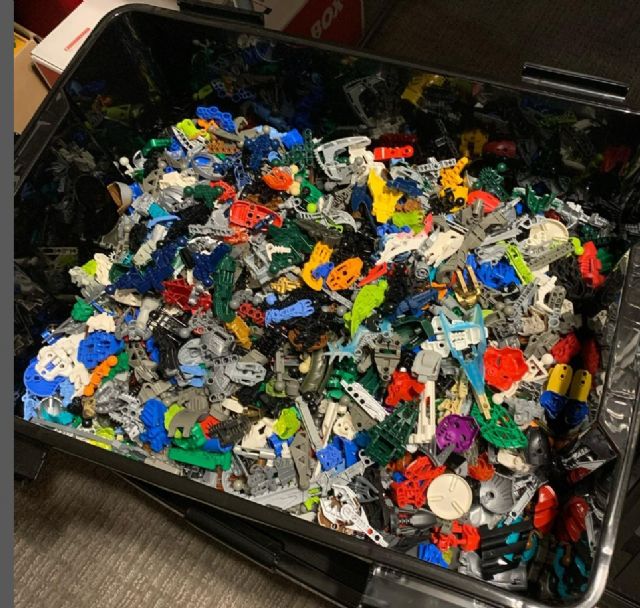
Here's a pic of all the bonk parts I siphoned out of a bunch of lots once
upon a time which happened to have a protodermis mask hiding in it.
In Selling, madeleine_ writes:
50-lbs lot of bulk + figs purchased for $468
I pulled 7-lbs of figs / accessories out and the BL value was $1145
Combined 10 used lots together and sorted all at once.
77-lbs purchased for $430
Listed 6-lbs of valuable stuff worth $1793
This is fascinating - thank you for sharing! Where do you find those types
of bulk lots? How can you be sure that another dealer hadn't sorted through
them before selling?


 USA
USA


 Canada, Ontario


 France, Provence-Alpes-Côte d'Azur


 United Kingdom, England

 Norway
 Spain, Comunidad Valenciana


 Where do you find those types