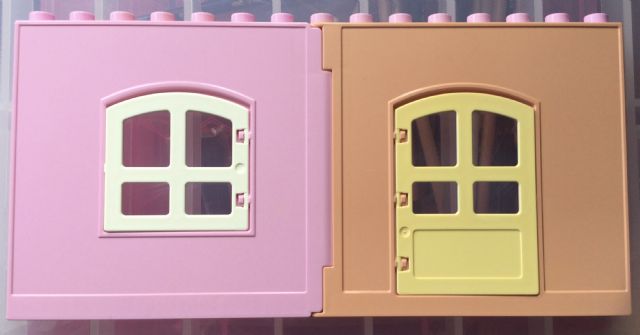
How’s this for colour change presumably due to sun exposure.
First three are the same pieces, front, back and door open to show door discolouration
and inside frame unaffected against a standard version.
Note door appears to be close to bright light yellow on outside but is white
on the inside.
Fourth and fifth show major fading one side and lesser on reverse and unaffected.
Quite like the effect, not sure anyone would have a use for these but who knows.
It is incredible isn't it. I wonder how long that was sitting on a windowsill
untouched. I have a baseplate somewhere that had parts attached and it looks
almost like the unfaded parts was printed.
As to if anyone would use it - I'm sure a kid would still play with them.
I had a load of duplo that wasn't good enough to sell here but priced low
on facebook and someone bought it for their daughter to play with.
Almost certain to end in in a large box of Duplo I have put aside for my Grandson.
In General, yorbrick writes:
In General, Stuart9 writes:
How’s this for colour change presumably due to sun exposure.
First three are the same pieces, front, back and door open to show door discolouration
and inside frame unaffected against a standard version.
Note door appears to be close to bright light yellow on outside but is white
on the inside.
Fourth and fifth show major fading one side and lesser on reverse and unaffected.
Quite like the effect, not sure anyone would have a use for these but who knows.
It is incredible isn't it. I wonder how long that was sitting on a windowsill
untouched. I have a baseplate somewhere that had parts attached and it looks
almost like the unfaded parts was printed.
As to if anyone would use it - I'm sure a kid would still play with them.
I had a load of duplo that wasn't good enough to sell here but priced low
on facebook and someone bought it for their daughter to play with.
How’s this for colour change presumably due to sun exposure. […]
Once again, sunlight doesn’t discolour, it helps the discolouration.
Humidity & temperature help too. And being hermetically sealed and protected
from changes in humidity, temperature, UVs, like parts hidden in a build / covered
by the parts they are connected to, helps to slow the discolouration.
How’s this for colour change presumably due to sun exposure. […]
Once again, sunlight doesn’t discolour, it helps the discolouration.
Humidity & temperature help too. And being hermetically sealed and protected
from changes in humidity, temperature, UVs, like parts hidden in a build / covered
by the parts they are connected to, helps to slow the discolouration.
What do you mean by "helps"? Last I checked, ABS or acrylonitrile butadiene
reacting to sunlight was a chemical reaction caused by the sunlight causing a
chemical change in the structure of the plastic due to the butadiene in it. That's
not a scientific definition of "helps".
State what you mean, it would help if you cite the sources you're citing
it from.
Once again, sunlight doesn’t discolour, it helps the discolouration
What do you mean by "helps"?
Sorry, I was in a hurry and didn’t word it the best way.
Shortly, what I meant is that UVs aren’t the one and only cause of discolouration.
Some of the chemical reactions that cause discolouration need UVs (or other light
rays), some are accelerated (“helped”) by light (but would happen anyway), and
some don’t need light at all.
The process through which ABS discolours is known as Photo-Oxidation. This happens
when it is exposed to light (Photo) and air (oxide).
Another process is called Photodegradation. This is caused mainly by light, however
oxides are also normally part of this process.
Oxydation isn’t only caused by light. There’s quite a few people with parts
that have discoloured while they were still in their original boxes, never under
sunlight.
Plastic degradation is also caused by thermooxidative reactions (heat) or biodegradation
(bacterias, fungi…).
There’s also a lot of things that can “help ” degradation/decolouration, like
traces of other compounds / materials (remnants of solvents, metals from contact
with tools…) and all the additives (mostly dyes but also compounds added for
other reasons (even those added to protect from degration)).
For more info search for "photo-oxidation of polymer chains"
Stuart's discolouration is most likely a reaction of the pigment or dye used
to colour the ABS.


 United Kingdom, England


)
)
)
)
)


 France, Nouvelle-Aquitaine
 Australia, Queensland

 ” degradation/decolouration, like
 )
)
 USA, Arkansas
 Canada, Ontario