I’m hoping that someone can offer some suggestions that I have not tried yet.
I have set # 7720. It was sitting in the basement for years. There is corrosion
on the metal conductors. I have used white vinegar and baking soda paste which
worked a bit. I also tried Coke but that was not so successful. I popped all
new batteries in and it is not working. There’s still some corrosion so that
might be the problem. Has anyone ever had this issue? What did you use? Did it
work when you were done?
I would appreciate any advice. I would hate to just have to part out this classic
set.
I’m hoping that someone can offer some suggestions that I have not tried yet.
I have set # 7720. It was sitting in the basement for years. There is corrosion
on the metal conductors. I have used white vinegar and baking soda paste which
worked a bit. I also tried Coke but that was not so successful. I popped all
new batteries in and it is not working. There’s still some corrosion so that
might be the problem. Has anyone ever had this issue? What did you use? Did it
work when you were done?
I would appreciate any advice. I would hate to just have to part out this classic
set.
If they are badly corroded, replacing the contacts is usually straightforward.
I keep the contact springs from other broken toys but you can buy them too.
Obviously declare it if you are selling it.
It is also a good idea to put the correct voltage across the two end terminals,
just to test the rest of the part actually works.
I’m hoping that someone can offer some suggestions that I have not tried yet.
I have set # 7720. It was sitting in the basement for years. There is corrosion
on the metal conductors. I have used white vinegar and baking soda paste which
worked a bit. I also tried Coke but that was not so successful. I popped all
new batteries in and it is not working. There’s still some corrosion so that
might be the problem. Has anyone ever had this issue? What did you use? Did it
work when you were done?
I would appreciate any advice. I would hate to just have to part out this classic
set.
If they are badly corroded, replacing the contacts is usually straightforward.
I keep the contact springs from other broken toys but you can buy them too.
Obviously declare it if you are selling it.
It is also a good idea to put the correct voltage across the two end terminals,
just to test the rest of the part actually works.
Yes, I would definitely let a potential buyer know. Some people are good at fixing
things like this and then there’s me. I’m not sure what you mean about putting
the correct voltage across it.
I’m hoping that someone can offer some suggestions that I have not tried yet.
I have set # 7720. It was sitting in the basement for years. There is corrosion
on the metal conductors. I have used white vinegar and baking soda paste which
worked a bit. I also tried Coke but that was not so successful. I popped all
new batteries in and it is not working. There’s still some corrosion so that
might be the problem. Has anyone ever had this issue? What did you use? Did it
work when you were done?
I would appreciate any advice. I would hate to just have to part out this classic
set.
If they are badly corroded, replacing the contacts is usually straightforward.
I keep the contact springs from other broken toys but you can buy them too.
Obviously declare it if you are selling it.
It is also a good idea to put the correct voltage across the two end terminals,
just to test the rest of the part actually works.
Yes, I would definitely let a potential buyer know. Some people are good at fixing
things like this and then there’s me. I’m not sure what you mean about putting
the correct voltage across it.
You need to have someone experienced in repairing electrical appliances and devices
to take a look at it. Specifically, they should know their way around small toy
motors.
If you have family or friends who are into repairing and restoring old electrical
equipment, they should be able to help.
Even a local model railroading or R/C airplanes or cars club could help diagnose
the issues.
I’m hoping that someone can offer some suggestions that I have not tried yet.
I have set # 7720. It was sitting in the basement for years. There is corrosion
on the metal conductors. I have used white vinegar and baking soda paste which
worked a bit. I also tried Coke but that was not so successful. I popped all
new batteries in and it is not working. There’s still some corrosion so that
might be the problem. Has anyone ever had this issue? What did you use? Did it
work when you were done?
I would appreciate any advice. I would hate to just have to part out this classic
set.
If they are badly corroded, replacing the contacts is usually straightforward.
I keep the contact springs from other broken toys but you can buy them too.
Obviously declare it if you are selling it.
It is also a good idea to put the correct voltage across the two end terminals,
just to test the rest of the part actually works.
Yes, I would definitely let a potential buyer know. Some people are good at fixing
things like this and then there’s me. I’m not sure what you mean about putting
the correct voltage across it.
I mean using 4.5V (so three 1.5V batteries) and using a couple of bits of wire
to connect them to the terminals where they disappear (not just connect one end
of the battery to the next). As this is just a simple motor, you don't even
need to worry about polarity ( positive and negative ). If you have an old USB
phone charger (it will be just under 5V) you could even cut the end off that
and use that to test it, just connect the wires to the two terminals. There is
no point cleaning up something if it doesn't work anyway.
I’m hoping that someone can offer some suggestions that I have not tried yet.
I have set # 7720. It was sitting in the basement for years. There is corrosion
on the metal conductors. I have used white vinegar and baking soda paste which
worked a bit. I also tried Coke but that was not so successful. I popped all
new batteries in and it is not working. There’s still some corrosion so that
might be the problem. Has anyone ever had this issue? What did you use? Did it
work when you were done?
I would appreciate any advice. I would hate to just have to part out this classic
set.
If they are badly corroded, replacing the contacts is usually straightforward.
I keep the contact springs from other broken toys but you can buy them too.
Obviously declare it if you are selling it.
It is also a good idea to put the correct voltage across the two end terminals,
just to test the rest of the part actually works.
Yes, I would definitely let a potential buyer know. Some people are good at fixing
things like this and then there’s me. I’m not sure what you mean about putting
the correct voltage across it.
I mean using 4.5V (so three 1.5V batteries) and using a couple of bits of wire
to connect them to the terminals where they disappear (not just connect one end
of the battery to the next). As this is just a simple motor, you don't even
need to worry about polarity ( positive and negative ). If you have an old USB
phone charger (it will be just under 5V) you could even cut the end off that
and use that to test it, just connect the wires to the two terminals. There is
no point cleaning up something if it doesn't work anyway.
I appreciate the advice. I’m not good with electricity. I’ve been zapped so that
is one thing I don’t take chances with- plumbing is the other 😁
[…]
I appreciate the advice. I’m not good with electricity. I’ve been zapped so that
is one thing I don’t take chances with- plumbing is the other 😁
Direct current from simple batteries is far from dangerous. Testing them on
your tongue is a long-proven method (well, only practical with 4.5V and 9V
).
[…]
I appreciate the advice. I’m not good with electricity. I’ve been zapped so that
is one thing I don’t take chances with- plumbing is the other 😁
Direct current from simple batteries is far from dangerous. Testing them on
your tongue is a long-proven method (well, only practical with 4.5V and 9V
).
A lot safer than a 220 line. I’m going to check with a few people that are better
at such things.
I’m hoping that someone can offer some suggestions that I have not tried yet.
I have set # 7720. It was sitting in the basement for years. There is corrosion
on the metal conductors. I have used white vinegar and baking soda paste which
worked a bit. I also tried Coke but that was not so successful. I popped all
new batteries in and it is not working. There’s still some corrosion so that
might be the problem. Has anyone ever had this issue? What did you use? Did it
work when you were done?
I would appreciate any advice. I would hate to just have to part out this classic
set.
I’m hoping that someone can offer some suggestions that I have not tried yet.
I have set # 7720. It was sitting in the basement for years. There is corrosion
on the metal conductors. I have used white vinegar and baking soda paste which
worked a bit. I also tried Coke but that was not so successful. I popped all
new batteries in and it is not working. There’s still some corrosion so that
might be the problem. Has anyone ever had this issue? What did you use? Did it
work when you were done?
I would appreciate any advice. I would hate to just have to part out this classic
set.
I’m hoping that someone can offer some suggestions that I have not tried yet.
I have set # 7720. It was sitting in the basement for years. There is corrosion
on the metal conductors. I have used white vinegar and baking soda paste which
worked a bit. I also tried Coke but that was not so successful. I popped all
new batteries in and it is not working. There’s still some corrosion so that
might be the problem. Has anyone ever had this issue? What did you use? Did it
work when you were done?
I would appreciate any advice. I would hate to just have to part out this classic
set.
Karen
Sounds your on the right track. If your vinegar still turns green after the bath,
it is not ready yet. Make sure the parts are not wet anymore before putting new
batteries in. Otherwise motor pieces will die before working again. If they are
completely dry and ready for testing spray (a small) bit of WD40 on the contacts
and in the motor.
I’m hoping that someone can offer some suggestions that I have not tried yet.
I have set # 7720. It was sitting in the basement for years. There is corrosion
on the metal conductors. I have used white vinegar and baking soda paste which
worked a bit. I also tried Coke but that was not so successful. I popped all
new batteries in and it is not working. There’s still some corrosion so that
might be the problem. Has anyone ever had this issue? What did you use? Did it
work when you were done?
I would appreciate any advice. I would hate to just have to part out this classic
set.
Karen
Sounds your on the right track. If your vinegar still turns green after the bath,
it is not ready yet. Make sure the parts are not wet anymore before putting new
batteries in. Otherwise motor pieces will die before working again. If they are
completely dry and ready for testing spray (a small) bit of WD40 on the contacts
and in the motor.
I’m hoping that someone can offer some suggestions that I have not tried yet.
I have set # 7720. It was sitting in the basement for years. There is corrosion
on the metal conductors. I have used white vinegar and baking soda paste which
worked a bit. I also tried Coke but that was not so successful. I popped all
new batteries in and it is not working. There’s still some corrosion so that
might be the problem. Has anyone ever had this issue? What did you use? Did it
work when you were done?
I would appreciate any advice. I would hate to just have to part out this classic
set.
Karen
Sounds your on the right track. If your vinegar still turns green after the bath,
it is not ready yet. Make sure the parts are not wet anymore before putting new
batteries in. Otherwise motor pieces will die before working again. If they are
completely dry and ready for testing spray (a small) bit of WD40 on the contacts
and in the motor.
Thank you all for your help. Fingers crossed!
Semi-dangerous engineer here... Assume when you place the 3x "C" batteries
into the red train car, connect the wires from it to the motor, and move the
lever on the tender car you get nothing, correct?
*
3443c02pb01 (Inv) Train Battery Box Car with Three Contact Holes, Red Switch Lever, Black Magnets, Black Wheels, and Light Gray Roof with 'DB 7722' Pattern on Both Sides (Stickers) - Set 7722 Parts: Train {Red}
*
766c28 (Inv) Electric, Wire 12V / 4.5V with 2 Leads, 28 Studs (22cm) Long with 2 Light Gray Electric, Connector, 2-Way Male Squared Narrow Long with Center Post Parts: Electric, Wire & Connector {Light Gray}
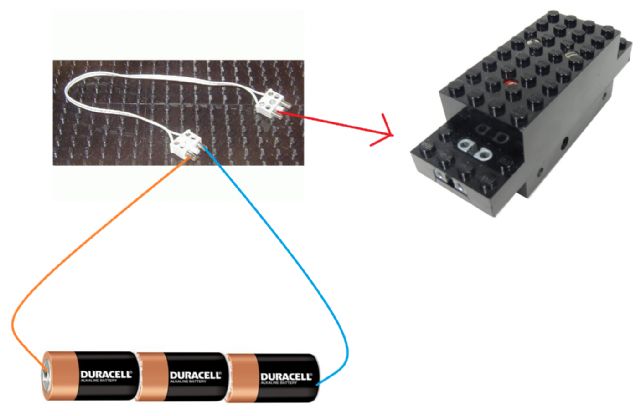
You can test the motor itself easily... Line up all three batteries end to end
(+/-; +/-; +/-), plug one end of the motor wire into the motor, and then the
other ends to each end of the battery you should get movement at the motor (you
will need to add some wire to the LEGO wire to reach both ends of the battery...
old wire you have, metal coat hanger, tin foil, etc.). And dont worry, you cannot
be zapped by this, too low of current. You also cant wire it wrong... the motor
will just run in reverse.
If this works, then you can isolate the issue to the red wagon contacts. Are
there any signs of visible corrosion on the contacts in the red wagon car? Let
us know and we can continue to trouble shoot.


 USA, Connecticut


 United Kingdom, England

 Australia, Queensland
 France, Nouvelle-Aquitaine
 Netherlands, Noord-Holland