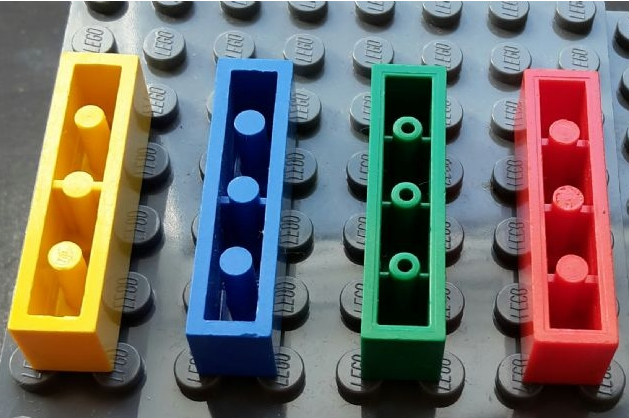
On Bricks 1x4 #3010 there are various bottom post configurations. When I look
at part 3010 on Bricklink, there is a nice photo (don't know who to credit
as no name showing), I am attaching here as a screen print. It shows the 4 different
bricks.
Do they have different purposes?
Were they made in different years?
Thanks!!
On Bricks 1x4 #3010 there are various bottom post configurations. When I look
at part 3010 on Bricklink, there is a nice photo (don't know who to credit
as no name showing), I am attaching here as a screen print. It shows the 4 different
bricks.
Do they have different purposes?
Were they made in different years?
Thanks!!
These are evolutions of the same brick with the same purpose. They were made
in different years, but there may have been overlap with older and newer molds
being in use simultaneously.
First iteration, yellow: stabilization of the side walls by a separator that
links every second pin to the wall.
Second iteration, blue: stabilization wall is lowered by half a plate, so that
it does no longer interfere when placing the brick at a half stud offset on open
studs.
Third iteration, red: improved stability by adding extra stability walls. This
also prevents the not-connected bottom pins to break off.
Fourth iteration, green: reducing the amount of plastic by making the bottom
pins hollow. Accidentally this also adds connectivity for hair accessories with
a 1 mm pin but I don't believe the holes in the brick's bottom pins have
been formally designed for this purpose.
---
For more these kinds of part evolutions and Lego's history, see also https://www.leggodt.nl
On Bricks 1x4 #3010 there are various bottom post configurations. When I look
at part 3010 on Bricklink, there is a nice photo (don't know who to credit
as no name showing), I am attaching here as a screen print. It shows the 4 different
bricks.
Do they have different purposes?
Were they made in different years?
Thanks!!
These are evolutions of the same brick with the same purpose. They were made
in different years, but there may have been overlap with older and newer molds
being in use simultaneously.
First iteration, yellow: stabilization of the side walls by a separator that
links every second pin to the wall.
Second iteration, blue: stabilization wall is lowered by half a plate, so that
it does no longer interfere when placing the brick at a half stud offset on open
studs.
Third iteration, red: improved stability by adding extra stability walls. This
also prevents the not-connected bottom pins to break off.
Fourth iteration, green: reducing the amount of plastic by making the bottom
pins hollow. Accidentally this also adds connectivity for hair accessories with
a 1 mm pin but I don't believe the holes in the brick's bottom pins have
been formally designed for this purpose.
---
For more these kinds of part evolutions and Lego's history, see also https://www.leggodt.nl
Accidentally this also adds connectivity for hair accessories with
a 1 mm pin but I don't believe the holes in the brick's bottom pins have
been formally designed for this purpose.


 USA, Alaska

 Netherlands, Groningen
