There is no minifigure built in this set. The legs of two minifigs are not built
under their torso. The third minifig does not even have a minifi.
Should rather the parts of the minifigs appear in the regular section?
According to the instructions, I agree with your assessment. Although, it could
be argued that the first two minifigures use the black 1x2 bricks as their legs.
I would not consider the third one to be a minifigure at all. I would like to
hear other opinions on this before we make changes.
There is no minifigure built in this set. The legs of two minifigs are not built
under their torso. The third minifig does not even have a minifi.
Should rather the parts of the minifigs appear in the regular section?
According to the instructions, I agree with your assessment. Although, it could
be argued that the first two minifigures use the black 1x2 bricks as their legs.
I would not consider the third one to be a minifigure at all. I would like to
hear other opinions on this before we make changes.
Cheers,
Randy
I also have more evidence concerning the inventory of this set.
There is no minifigure built in this set. The legs of two minifigs are not built
under their torso. The third minifig does not even have a minifi.
Should rather the parts of the minifigs appear in the regular section?
According to the instructions, I agree with your assessment. Although, it could
be argued that the first two minifigures use the black 1x2 bricks as their legs.
I would not consider the third one to be a minifigure at all. I would like to
hear other opinions on this before we make changes.
Cheers,
Randy
There is an exception with these early "stiff" minifigures. Because they often
had to be built into the model, we don't use the instructions as the final
word on how they are listed in the inventory. So I would say the two with offset
legs should absolutely be listed as whole minifigs, because this is how these
figures were often made to "sit".
In the early days of BrickLink inventories, sometimes these types of cases resulted
in minifigures being listed as counterparts. But that's a bad precedent to
set, and most or all of these have since been moved to the regular section.
The one on the horse is tough, because of examples like this:
Here, no minifigs have ever been added, presumably because it would be strange
to list this set as having only 2 or 3 minifigs when it could be argued that
there are 6. So until now, this set has been treated like those LEGO Education
packs where no minifigs are defined and everything is just loose parts in the
inventory.
There is no minifigure built in this set. The legs of two minifigs are not built
under their torso. The third minifig does not even have a minifi.
Should rather the parts of the minifigs appear in the regular section?
According to the instructions, I agree with your assessment. Although, it could
be argued that the first two minifigures use the black 1x2 bricks as their legs.
I would not consider the third one to be a minifigure at all. I would like to
hear other opinions on this before we make changes.
Cheers,
Randy
There is an exception with these early "stiff" minifigures. Because they often
had to be built into the model, we don't use the instructions as the final
word on how they are listed in the inventory. So I would say the two with offset
legs should absolutely be listed as whole minifigs, because this is how these
figures were often made to "sit".
In the early days of BrickLink inventories, sometimes these types of cases resulted
in minifigures being listed as counterparts. But that's a bad precedent to
set, and most or all of these have since been moved to the regular section.
The one on the horse is tough, because of examples like this:
Here, no minifigs have ever been added, presumably because it would be strange
to list this set as having only 2 or 3 minifigs when it could be argued that
there are 6. So until now, this set has been treated like those LEGO Education
packs where no minifigs are defined and everything is just loose parts in the
inventory.
Since there is so much confusion with these early stiff figures, I wonder if
it is even necessary to list them as full minifigures unless they were ever shown
as full figures in the instructions. It seems like the parts were just meant
to be used to build a lot of different play scenarios instead of actually represent
a whole figure. I hate exceptions, and an exception for these early figures seems
uncalled for. This probably needs to be wrapped into Project 23 on the Catalog
Roadmap.
There is no minifigure built in this set. The legs of two minifigs are not built
under their torso. The third minifig does not even have a minifi.
Should rather the parts of the minifigs appear in the regular section?
According to the instructions, I agree with your assessment. Although, it could
be argued that the first two minifigures use the black 1x2 bricks as their legs.
I would not consider the third one to be a minifigure at all. I would like to
hear other opinions on this before we make changes.
Cheers,
Randy
There is an exception with these early "stiff" minifigures. Because they often
had to be built into the model, we don't use the instructions as the final
word on how they are listed in the inventory. So I would say the two with offset
legs should absolutely be listed as whole minifigs, because this is how these
figures were often made to "sit".
In the early days of BrickLink inventories, sometimes these types of cases resulted
in minifigures being listed as counterparts. But that's a bad precedent to
set, and most or all of these have since been moved to the regular section.
The one on the horse is tough, because of examples like this:
Here, no minifigs have ever been added, presumably because it would be strange
to list this set as having only 2 or 3 minifigs when it could be argued that
there are 6. So until now, this set has been treated like those LEGO Education
packs where no minifigs are defined and everything is just loose parts in the
inventory.
Since there is so much confusion with these early stiff figures, I wonder if
it is even necessary to list them as full minifigures unless they were ever shown
as full figures in the instructions. It seems like the parts were just meant
to be used to build a lot of different play scenarios instead of actually represent
a whole figure. I hate exceptions, and an exception for these early figures seems
uncalled for. This probably needs to be wrapped into Project 23 on the Catalog
Roadmap.
Cheers,
Randy
I would agree that it would be easier if we just started with minifigs in 1978
with the moveable arms and legs. After all, we don't list these as minifigs:
*
685px3c01 (Inv) Homemaker Figure / Maxifigure Torso Assembly with Yellow Head with Black Eyes, Freckles, and Smile Pattern (792c03 / 685px3) Parts: Homemaker
The problem, though, is that the stiff minifigs *were* the original minifigure
as described by the LEGO Group in their literature. Are we really going to remove
those figures from the catalog? Minifigs as a whole sell much better than the
separate parts, and the tendency of the market would actually be to go the other
way and start listing the large figures in inventories as well.
There is no minifigure built in this set. The legs of two minifigs are not built
under their torso. The third minifig does not even have a minifi.
Should rather the parts of the minifigs appear in the regular section?
According to the instructions, I agree with your assessment. Although, it could
be argued that the first two minifigures use the black 1x2 bricks as their legs.
I would not consider the third one to be a minifigure at all. I would like to
hear other opinions on this before we make changes.
Cheers,
Randy
There is an exception with these early "stiff" minifigures. Because they often
had to be built into the model, we don't use the instructions as the final
word on how they are listed in the inventory. So I would say the two with offset
legs should absolutely be listed as whole minifigs, because this is how these
figures were often made to "sit".
In the early days of BrickLink inventories, sometimes these types of cases resulted
in minifigures being listed as counterparts. But that's a bad precedent to
set, and most or all of these have since been moved to the regular section.
The one on the horse is tough, because of examples like this:
Here, no minifigs have ever been added, presumably because it would be strange
to list this set as having only 2 or 3 minifigs when it could be argued that
there are 6. So until now, this set has been treated like those LEGO Education
packs where no minifigs are defined and everything is just loose parts in the
inventory.
Since there is so much confusion with these early stiff figures, I wonder if
it is even necessary to list them as full minifigures unless they were ever shown
as full figures in the instructions. It seems like the parts were just meant
to be used to build a lot of different play scenarios instead of actually represent
a whole figure. I hate exceptions, and an exception for these early figures seems
uncalled for. This probably needs to be wrapped into Project 23 on the Catalog
Roadmap.
Cheers,
Randy
I would agree that it would be easier if we just started with minifigs in 1978
with the moveable arms and legs. After all, we don't list these as minifigs:
*
685px3c01 (Inv) Homemaker Figure / Maxifigure Torso Assembly with Yellow Head with Black Eyes, Freckles, and Smile Pattern (792c03 / 685px3) Parts: Homemaker
The problem, though, is that the stiff minifigs *were* the original minifigure
as described by the LEGO Group in their literature. Are we really going to remove
those figures from the catalog?
Could you point me towards some literature that shows this? I am interested in
learning more.
Minifigs as a whole sell much better than the
separate parts, and the tendency of the market would actually be to go the other
way and start listing the large figures in inventories as well.
I agree, but what kind of a market are we talking about for these types of minifigs?
I would agree that it would be easier if we just started with minifigs in 1978
with the moveable arms and legs. After all, we don't list these as minifigs:
*
685px3c01 (Inv) Homemaker Figure / Maxifigure Torso Assembly with Yellow Head with Black Eyes, Freckles, and Smile Pattern (792c03 / 685px3) Parts: Homemaker
The problem, though, is that the stiff minifigs *were* the original minifigure
as described by the LEGO Group in their literature. Are we really going to remove
those figures from the catalog?
Could you point me towards some literature that shows this? I am interested in
learning more.
Minifigs as a whole sell much better than the
separate parts, and the tendency of the market would actually be to go the other
way and start listing the large figures in inventories as well.
I agree, but what kind of a market are we talking about for these types of minifigs?
Most vintage items will never sell like the newest minifig series or even the
early Star Wars sets. There just wasn't the volume of sales in the 1970's
as there is today, so it has to be seen in context.
But I think most sellers would jump at the chance to list the big figures from
the 1970's if they occupied the minifig position in inventories. But right
now, each part of those figures is listed separately. In reality the head, torso,
arms and hands came fully assembled in every market outside of Canada. See here
for more info:
I would agree that it would be easier if we just started with minifigs in 1978
with the moveable arms and legs. After all, we don't list these as minifigs:
*
685px3c01 (Inv) Homemaker Figure / Maxifigure Torso Assembly with Yellow Head with Black Eyes, Freckles, and Smile Pattern (792c03 / 685px3) Parts: Homemaker
The problem, though, is that the stiff minifigs *were* the original minifigure
as described by the LEGO Group in their literature. Are we really going to remove
those figures from the catalog?
Could you point me towards some literature that shows this? I am interested in
learning more.
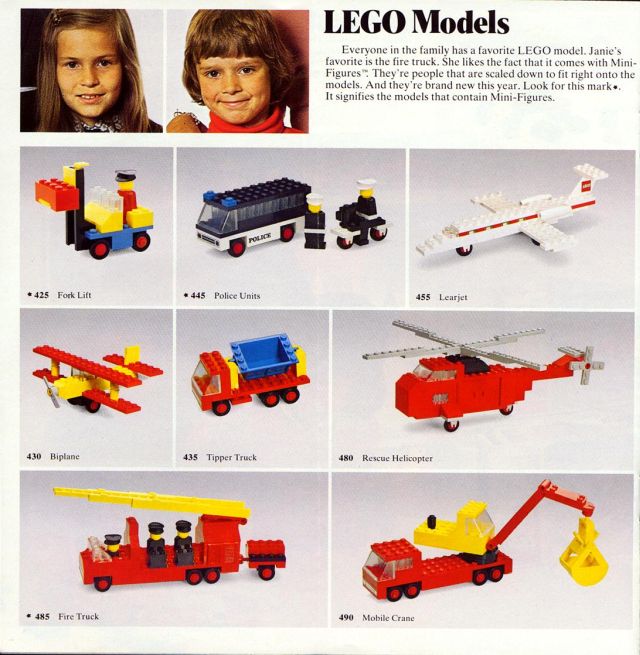
It is neat to see that they went from calling them "Mini-Figures", which is much
more grammatically correct, to "minifigures".
Minifigs as a whole sell much better than the
separate parts, and the tendency of the market would actually be to go the other
way and start listing the large figures in inventories as well.
I agree, but what kind of a market are we talking about for these types of minifigs?
Most vintage items will never sell like the newest minifig series or even the
early Star Wars sets. There just wasn't the volume of sales in the 1970's
as there is today, so it has to be seen in context.
Yep, totally understand. I didn't mean to sound like the market didn't
matter.
But I think most sellers would jump at the chance to list the big figures from
the 1970's if they occupied the minifig position in inventories.
It is definitely something that we should look into when we define all of the
types of figures and how they will occupy the inventories.
But right
now, each part of those figures is listed separately. In reality the head, torso,
arms and hands came fully assembled in every market outside of Canada. See here
for more info:
Should rather the parts of the minifigs appear in the regular section?
Eventually they will appear there when the system is fixed so that figures can
be listed as counterpart assemblies in inventories. I would imagine once that
happens it will loosen our need to be so pedantic about the precise assemblies
of figures.
Until then (and who knows when the site will fix this for us?) I'd say it's
just something we'll have to live with.


 Canada, British Columbia


 USA, Ohio