3003 has inside supports, 3003old doesn't - no problem with that
The trans coloured ones (i have trans-green to hand), do not have the internal
supports, but are treated at 3003 and not 3003old, as they are still being produced.
Surely this is incorrect
Can someone explain why bricks modelled as 3003old are being labelled as 3003
- and how do you explain that to someone if they wanted to add a red brick to
the catalogue!
IMO the seperate catelog entry 3003old is questionable. 3001old and 3002old are
clear, these do not have cross support as 3001 and 3002 do. But 3003 does not
come with cross support, and never have. However 3001 and 3002 do come with and
without inner supports but there is no seperate entry for those. So why 3003old?
I do not know. Clearly it raises more questions than answers.
3003 has inside supports, 3003old doesn't - no problem with that
The trans coloured ones (i have trans-green to hand), do not have the internal
supports, but are treated at 3003 and not 3003old, as they are still being produced.
Surely this is incorrect
Can someone explain why bricks modelled as 3003old are being labelled as 3003
- and how do you explain that to someone if they wanted to add a red brick to
the catalogue!
IMO the seperate catelog entry 3003old is questionable. 3001old and 3002old are
clear, these do not have cross support as 3001 and 3002 do. But 3003 does not
come with cross support, and never have. However 3001 and 3002 do come with and
without inner supports but there is no seperate entry for those. So why 3003old?
I do not know. Clearly it raises more questions than answers.
3003 has inside supports, 3003old doesn't - no problem with that
The trans coloured ones (i have trans-green to hand), do not have the internal
supports, but are treated at 3003 and not 3003old, as they are still being produced.
Surely this is incorrect
Can someone explain why bricks modelled as 3003old are being labelled as 3003
- and how do you explain that to someone if they wanted to add a red brick to
the catalogue!
Thanks
tpr
Hi
The "supports" in 3003 are more like friction ridges - not supports
IMO the seperate catelog entry 3003old is questionable. 3001old and 3002old are
clear, these do not have cross support as 3001 and 3002 do. But 3003 does not
come with cross support, and never have. However 3001 and 3002 do come with and
without inner supports but there is no seperate entry for those. So why 3003old?
I do not know. Clearly it raises more questions than answers.
3003 has inside supports, 3003old doesn't - no problem with that
The trans coloured ones (i have trans-green to hand), do not have the internal
supports, but are treated at 3003 and not 3003old, as they are still being produced.
Surely this is incorrect
Can someone explain why bricks modelled as 3003old are being labelled as 3003
- and how do you explain that to someone if they wanted to add a red brick to
the catalogue!
Thanks
tpr
Hi
The "supports" in 3003 are more like friction ridges - not supports
tpr
Afaik the walls of the brick are slightly thinner then older bricks, to save
on plastic, hence the supports or ridges
IMO the seperate catelog entry 3003old is questionable. 3001old and 3002old are
clear, these do not have cross support as 3001 and 3002 do. But 3003 does not
come with cross support, and never have. However 3001 and 3002 do come with and
without inner supports but there is no seperate entry for those. So why 3003old?
I do not know. Clearly it raises more questions than answers.
The inner supports talked about are the ribs on the thin sides, the old bricks
had thick walls.
I think you mixed up the cross supports with those.
Maybe come back to LEGO more
Anyway, the 3003old does have a function for the older thick walled 3003 bricks.
But as the OP points out, there are still thick walled bricks being made.
Especially in trans colors.
I would add the new 3003 thick walled bricks under 3003, not 3003old.
3003 has inside supports, 3003old doesn't - no problem with that
The trans coloured ones (i have trans-green to hand), do not have the internal
supports, but are treated at 3003 and not 3003old, as they are still being produced.
Surely this is incorrect
Can someone explain why bricks modelled as 3003old are being labelled as 3003
- and how do you explain that to someone if they wanted to add a red brick to
the catalogue!
But if you have a second hand thick walled 2x2 brick, how do you know if it is
a 3003old if you are putting new ones in 3003?
tpr
In Catalog, maxx3001 writes:
In Catalog, patpendlego writes:
IMO the seperate catelog entry 3003old is questionable. 3001old and 3002old are
clear, these do not have cross support as 3001 and 3002 do. But 3003 does not
come with cross support, and never have. However 3001 and 3002 do come with and
without inner supports but there is no seperate entry for those. So why 3003old?
I do not know. Clearly it raises more questions than answers.
The inner supports talked about are the ribs on the thin sides, the old bricks
had thick walls.
I think you mixed up the cross supports with those.
Maybe come back to LEGO more
Anyway, the 3003old does have a function for the older thick walled 3003 bricks.
But as the OP points out, there are still thick walled bricks being made.
Especially in trans colors.
I would add the new 3003 thick walled bricks under 3003, not 3003old.
3003 has inside supports, 3003old doesn't - no problem with that
The trans coloured ones (i have trans-green to hand), do not have the internal
supports, but are treated at 3003 and not 3003old, as they are still being produced.
Surely this is incorrect
Can someone explain why bricks modelled as 3003old are being labelled as 3003
- and how do you explain that to someone if they wanted to add a red brick to
the catalogue!
But if you have a second hand thick walled 2x2 brick, how do you know if it is
a 3003old if you are putting new ones in 3003?
By your own choice of where you think it will sell best.
There is nothing holding you from uploading 3003old, 3002old and 3001old under
the 3003, 3002 and 3001 listings....
These extra listings were only made to make it easier for old set restorers to
find the right parts.
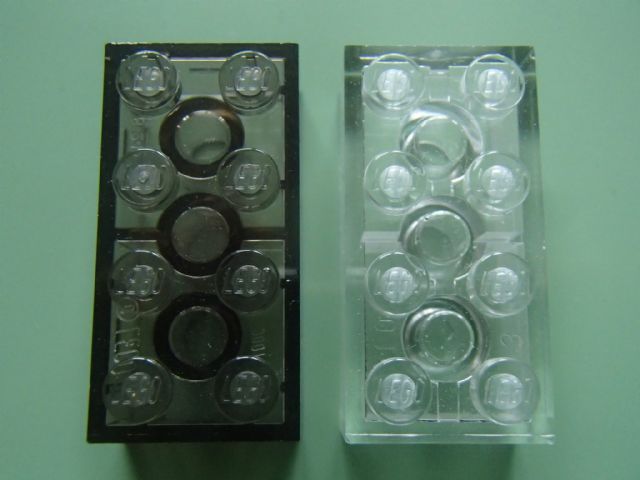
See picture, both are 3001, but the trans-black has thin walls while the trans-clear
has thick walls.
Both are still 2x4 bricks, like how humans will always be part of the great ape
family.
These extra listings were only made to make it easier for old set restorers to
find the right parts.
I'm one of these restorers and I don't mind, if there is some generic
part listing in the inventory first. But I want an opportunity to drill down
for each part, which variants are known. At least I want to have some estimated
time frame from when til when certain variants were common.
A linked discussion per set, in which proven part variants may be shown, would
be the perfect solution, because it may shed some light if varying part combinations
really existed in original packages (which I dare to doubt even in long production
periods).
So there should definitely be a way for lovers of deeper insight to find such
info on BrickLink - where else?


 United Kingdom, England


 Netherlands, Overijssel


 Germany, Brandenburg